Buddha's Birthday (부처님 오신 날): 4 Cultural Lessons Every Korean Learner Should Know
The hidden language and culture lessons inside Korea's most photogenic public holiday.
If you've been learning Korean for any length of time, you've probably stumbled across the phrase 부처님 오신 날 somewhere — on a Korean calendar, in a K-drama, or maybe in a Korean friend's Instagram story full of glowing paper lanterns.
It looks beautiful. But what is it, exactly? And why does the date keep changing every year?
Buddha's Birthday (부처님 오신 날) is one of the most visually stunning public holidays in Korea, falling on Sunday, May 24 in 2026. But for Korean language learners, it's also a treasure chest of insights about how the Korean language and society actually work.
Here are four things you'll wish someone had told you sooner.
#1: The Name Changed in 2018 — And That Says A Lot About Korean Culture
Here's something most casual learners don't know: this holiday used to be called something completely different.
For decades, the official name in Korea was 석가탄신일 (Seokga Tansinil) — a name built from Chinese characters that literally means "the day of Shakyamuni's birth." It's formal, scholarly, and very Sino-Korean (한자어).
Then, in 2018, the South Korean government officially changed the name to 부처님 오신 날 (Bucheonim Osin Nal) — "The Day Buddha Came." Warmer. Softer. And almost entirely pure Korean (순우리말).
Why Korean Learners Should Care
This name change isn't just a Buddhist-community decision — it reflects a much bigger trend in modern Korean.
Over the past few decades, Korean society has been gradually replacing Sino-Korean (한자어) terms with native Korean (순우리말) alternatives in everyday life. Words feel friendlier, easier to read, and more connected to spoken language.
You'll see this pattern everywhere once you notice it:
- Old, formal restaurant menus used to be filled with 한자어. Newer, trendier cafés use 순우리말 names.
- Government documents are being rewritten to be more accessible.
- Even kids' textbooks now favor 순우리말 wherever possible.
So when you compare 석가탄신일 vs 부처님 오신 날, you're not just looking at two ways to say the same thing. You're watching Korean culture make a small, beautiful choice about what kind of language it wants to use in the future.
#2: Why the Date Changes Every Year (음력 Lunar Calendar 101)
If you're an English-speaking learner, this might confuse you at first: the date of 부처님 오신 날 moves every year.
In 2025, it was May 5. In 2026, it's May 24. In 2027, it'll be May 13.
The reason? Korea still observes many traditional holidays on the 음력 (lunar calendar), not the regular 양력 (solar calendar) the rest of daily life uses.
Buddha's Birthday is always the 8th day of the 4th lunar month — which translates to a different solar date every year.
Other Holidays That Follow the Same Rule
Once you understand 음력, you suddenly understand a lot of Korean holidays at once:
Holiday | When (Lunar) |
설날 (Seollal) — Lunar New Year | 1st day of 1st lunar month |
추석 (Chuseok) — Korean Thanksgiving | 15th day of 8th lunar month |
부처님 오신 날 — Buddha's Birthday | 8th day of 4th lunar month |
Why does Korea hold on to the lunar calendar? Two reasons. First, tradition: these dates have been observed for over a thousand years. Second, the moon matters culturally — many Korean holidays are about family gatherings, ancestor rituals, and seasonal change, all of which were originally tied to lunar cycles.
If you ever want to impress a Korean friend, casually mention: "오늘이 음력 며칠이에요?" (What day is it on the lunar calendar today?) Most younger Koreans don't even know the lunar date offhand, but they'll be impressed you asked.
#3: The Magic of 대체공휴일 (Substitute Holiday) ⭐
This is the section that working Koreans get genuinely excited about — and it's something most foreigners don't realize exists.
In Korea, when a public holiday falls on a Sunday or overlaps with another holiday, the government often grants a 대체공휴일 (Dae-che Gong-hyu-il / "Substitute Holiday") — basically, a bonus day off on the following weekday to make up for it.
What This Means for 2026
Because Buddha's Birthday in 2026 falls on a Sunday (May 24), the following Monday (May 25) is a 대체공휴일. So:
- Sunday, May 24 → Buddha's Birthday (holiday)
- Monday, May 25 → 대체공휴일 (substitute holiday)
- Result? A real 3-day weekend.
For Korean office workers, this is a small national celebration of its own. Travel bookings spike. Highways jam. Cafés and theme parks fill up. The Korean phrase you'll hear everywhere is "황금연휴" (golden long weekend).
Why Korean Learners Should Know This Word
대체공휴일 is one of those words that appears constantly in real Korean life — in news headlines, in office Slack chats, in your Korean friend's "이번 주말 뭐해?" (What are you doing this weekend?) messages — but never shows up in most textbooks.
Learn it once, and Korean calendar conversations suddenly make sense.
#4: The Lantern Festival (연등회) — And Where to See It in Seoul
Buddha's Birthday isn't just about the day itself. The real spectacle starts weeks before.
For about two weeks leading up to May 24, Seoul slowly fills with 연등 (yeon-deung / lotus lanterns) — strung up along temple courtyards, Cheonggyecheon Stream, and Jongno's main streets. The festival, called 연등회 (Yeondeunghoe / Lotus Lantern Festival), is so culturally significant that UNESCO inscribed it as an Intangible Cultural Heritage of Humanity in 2020.
The biggest event is the Lantern Parade through Jongno — tens of thousands of people carrying handmade lanterns shaped like lotus flowers, dragons, and even cartoon characters. In 2026, the parade weekend is May 16–17, the weekend before Buddha's Birthday.
Want to See It Without the Crowds? Go to 봉은사 (Bongeunsa)
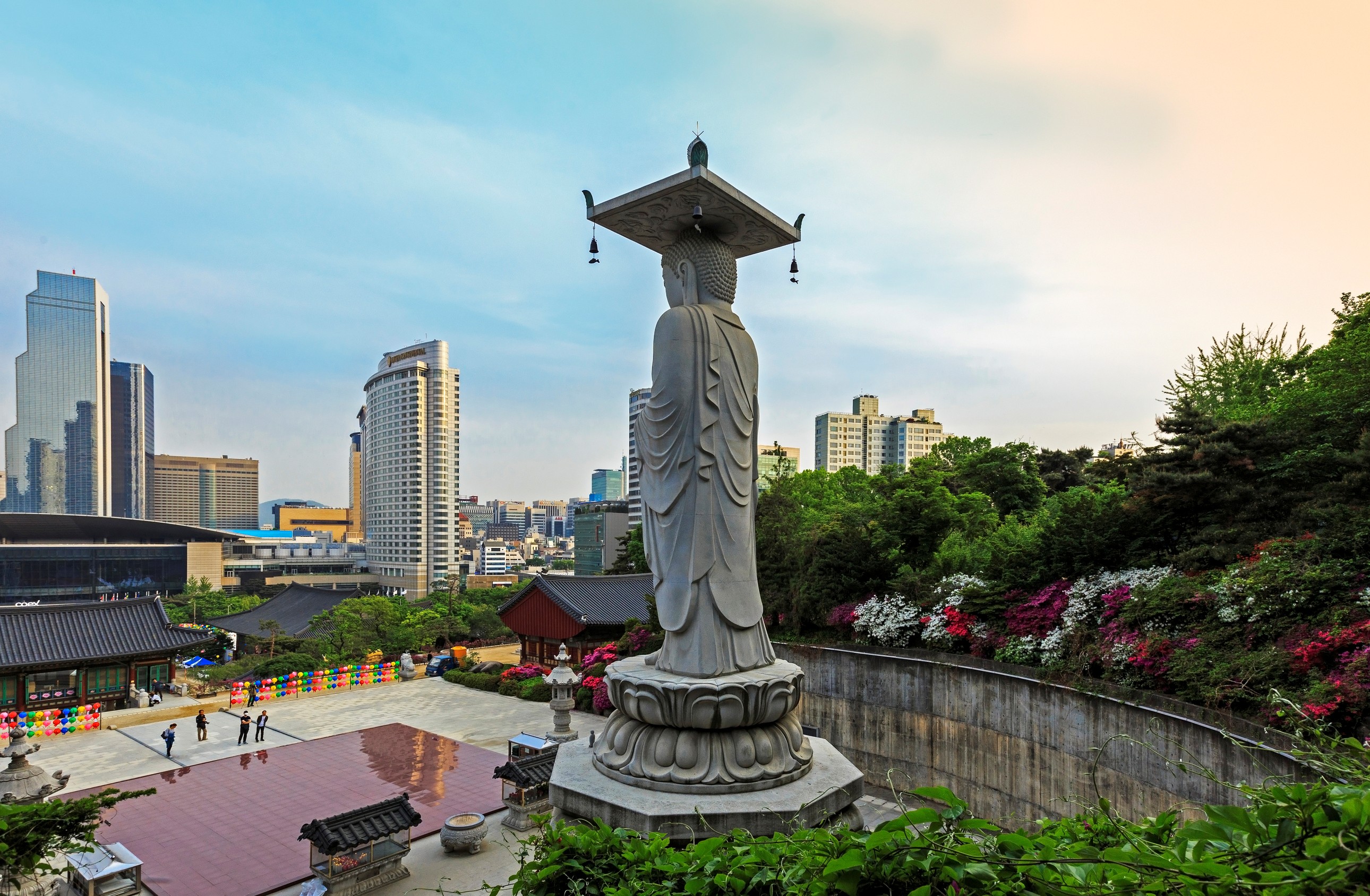
If the Jongno crowds feel overwhelming, here's a quieter recommendation: 봉은사 (Bongeunsa Temple) in Gangnam.
Why Bongeunsa is great for first-timers:
- 🚇 Easy to reach — Bongeunsa Station, Line 9, Exit 1. Less than a minute on foot.
- 🌆 Right next to COEX Mall — you can pair it with shopping or a meal nearby.
- 🪔 Stunning lantern display during the Buddha's Birthday season — the entire courtyard glows in the evening.
- 🤫 Quieter than Jogyesa in central Seoul, but just as beautiful.
- 💰 Free to enter, anytime.
It's the rare Seoul experience where you can step from a Gangnam shopping district into 1,200 years of tradition in about 30 seconds. The contrast alone is worth the visit.
Korean Vocabulary for Buddha's Birthday
| Korean | Romanization | Meaning |
|---|---|---|
| 부처님 오신 날 | Bucheonim Osin Nal | Buddha's Birthday |
| 음력 | eum-nyeok | Lunar calendar |
| 대체공휴일 | dae-che gong-hyu-il | Substitute public holiday |
| 연등 | yeon-deung | Lotus lantern |
| 절 | jeol | Buddhist temple |
Sample sentence:
부처님 오신 날이 일요일이라 월요일이 대체공휴일이에요!
"Buddha's Birthday falls on Sunday, so Monday is a substitute holiday!"
That one sentence uses three of the words above — and it's the exact kind of thing a Korean coworker would actually say in May.
Small Holidays, Big Language Lessons
Buddha's Birthday is one of those holidays that, on the surface, feels purely about Buddhism. But for Korean learners, it's a chance to absorb something much wider — how the Korean language evolves, how the lunar calendar still shapes daily life, and how a single Sunday holiday can quietly hand the whole country a 3-day weekend.
Languages aren't just grammar and vocabulary lists. They're built out of holidays, calendars, and small cultural choices like what to name something. Once you start noticing those, Korean stops feeling like a textbook and starts feeling like a place.
Want to learn Korean the way it's actually lived — holidays, slang, and all? At Seoul X On, our online Korean lessons are built around the cultural context that makes the language come alive. Try a free trial lesson and start learning Korean beyond the textbook.