How Korea Survives Summer: Hot Chicken Soup, Han River Nights, and the Subway AC Wars
Why do Koreans eat boiling-hot soup on the hottest day of the year? A foreigner's guide to surviving — and loving — a Korean summer, one cultural surprise at a time.
A Korean summer is not subtle. From late June, the 장마 (jangma) — monsoon rain season rolls in, blanketing the country in humidity. Then comes the real heat: weeks of temperatures pushing 33–35°C, sticky nights, and an intensity that catches a lot of first-time visitors completely off guard.
But here's the thing — Koreans have spent centuries figuring out how to beat this heat, and some of their methods will surprise you. (One of them involves eating soup hot enough to make you sweat more.) Here's your guide to surviving a Korean summer like a local — and picking up some very useful Korean along the way.
Why Koreans Eat Hot Soup on the Hottest Days 🍲
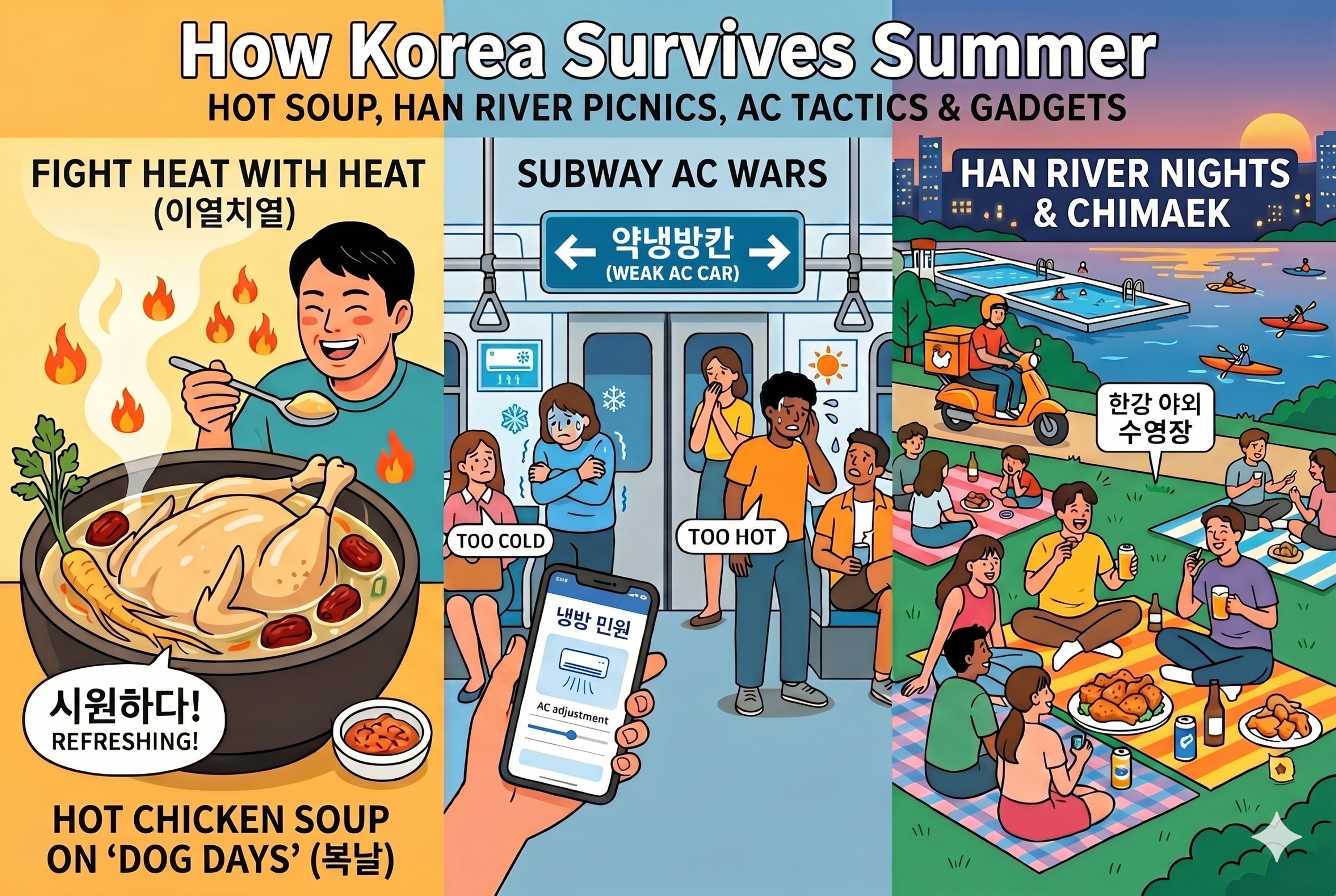
This is the one that breaks every foreigner's brain. On the three hottest, most brutal days of the Korean summer — the 복날 (boknal), or "dog days" — Koreans line up, sometimes for an hour, to eat a bowl of 삼계탕 (samgyetang): a whole young chicken stuffed with rice, ginseng, and jujube, simmered in a boiling-hot broth.
Boiling soup. On a 35°C day. On purpose. Why?
The answer is a wonderful Korean philosophy called 이열치열 (i-yeol-chi-yeol) — literally "fight heat with heat." The idea: in extreme summer heat, your body's core actually cools down while your skin sweats, leaving you drained. Eating something hot makes you sweat more, which cools you as it evaporates, and the nourishing broth restores the energy the heat has sapped. It's the opposite of reaching for ice cream — and after a bowl of samgyetang, many people genuinely do feel restored rather than overheated.
There are three official "dog days" spread across mid-July to mid-August — 초복 (chobok), 중복 (jungbok), and 말복 (malbok). In 2026, they fall on July 15, July 25, and August 14. Mark them: that's when the whole country eats chicken soup together.
💡 Pro tip: Samgyetang restaurants are packed on 복날. If you want to join in, book a few days ahead or expect a long wait.
"Siwonhada": The Word That Means Both Cold AND Hot 🤯
Here's a language twist that follows directly from that hot soup.
The Korean word 시원하다 (siwonhada) usually translates to "cool" or "refreshing" — what you'd say about an air-conditioned room or a cold drink. But Koreans also say 시원하다 when they take a sip of that boiling-hot soup, or step into a steaming-hot bath.
Wait — how can hot soup be "cool"?
Because 시원하다 doesn't really mean "cold." It means something closer to "refreshing, satisfying, a relief that clears you out." A cold drink on a hot day is 시원하다. But so is a hot broth that makes you sweat and sigh with relief. So is a hot spring that loosens your tired muscles. Once you understand 시원하다, you understand a whole layer of how Koreans experience comfort — it's about release, not temperature.
You'll hear older Koreans let out a satisfied "시원~하다!" after a spoonful of scalding soup. Now you know it's not a contradiction — it's poetry.
The Subway AC Wars: "Too Hot" vs. "Too Cold" 🚇
Step onto the Seoul subway in summer and you'll walk into one of the city's quietest, funniest battles: the 냉방 민원 (naengbang minwon) — air-conditioning complaints.
Korea's subway is gloriously air-conditioned, but everyone's body is different — so on the same train car, one passenger files a "too hot!" complaint while another files "too cold!" at the same moment. The numbers are staggering: temperature complaints are the single most common subway grievance, numbering in the hundreds of thousands each summer.
Two things make this very Korean:
1. The 약냉방칸 (yak-naengbang-kan) — "weak AC car." Most subway lines designate specific cars kept a degree or two warmer for people who get cold easily. (On lines 1, 3, and 4 it's typically the 4th and 7th cars; line 2, always the most crowded, skips it entirely.) If you're shivering, move to the weak-AC car; if you're roasting, avoid it.
2. You can literally text the train to change the temperature. Through the official 또타지하철 (Ttota Subway) app, riders can file a real-time "too hot / too cold" request that gets passed to the train's operator. It's a uniquely Korean blend of high-tech convenience and collective politeness — instead of suffering in silence, you send a quick request and the driver adjusts.
A local hack: the coldest spots are the seats at both ends of each car (near the priority seating), and the warmest is the middle. Position yourself accordingly.
Where Everyone Actually Goes: The Han River 🌊
When the sun goes down and the heat finally breaks, all of Seoul migrates to one place: the 한강 (Hangang) — the Han River. A summer night at a 한강공원 (Han River park) is the single most beloved way Koreans beat the heat, and it's a must-do for visitors.
Here's what to do:
- Han River outdoor pools 🏊 — In summer, the city opens free-standing outdoor swimming pools and water-play areas at parks like Ttukseom and Yeouido. In 2026 they run from late June through late August, with separate pools for adults, teens, and little kids. Cheap, breezy, and full of locals.
- Sunset kayaking & canoeing 🛶 — Several parks (Ttukseom, Jamwon, Banpo) rent kayaks and canoes, with sunset paddles the most popular slot (often around ₩30,000 for a session). Gliding across the water as the city lights flick on is unforgettable. Reserve ahead for sunset times.
- 치맥 picnic on the grass 🍗🍺 — The crown jewel. Spread out a mat, and order 치맥 (chimaek) — fried chicken + beer — delivered directly to your spot on the riverbank. Delivery apps now support foreign cards and English, and you can drop a GPS pin right on the lawn. This is peak Seoul summer.
Combine all three — swim in the afternoon, paddle at sunset, picnic after dark — and you've had a perfect Korean summer day.
The Summer Survival Kit: Gadgets Koreans Swear By 🧰
Spend one day in summer Seoul and you'll notice locals are equipped. Korea has turned beating the heat into a whole product category, and these cheap, genius items (mostly available at Daiso for a few thousand won) are exactly what foreign visitors end up buying — and loving.
- 손풍기 (son-pung-gi) — the handheld fan. The undisputed king of Korean summer. 손풍기 literally means "hand fan" (손 = hand + 풍 = wind/fan), and it's a small, rechargeable, battery-powered fan you carry everywhere. After the brutal heatwaves of 2017–2018, it became a genuine national essential — on the subway, on the street, in cafés, you'll see people of all ages holding one up to their face. To first-timers the sight looks funny; after one humid afternoon, they get it immediately and buy their own. Many newer models hang around your neck (넥밴드, "neckband") so your hands stay free.
- 쿨링 물티슈 (cooling wipes). Wet wipes with a menthol-like cooling agent that drop your skin temperature the second you wipe your neck or arms. A lifesaver when it's too sticky to function and a shower isn't an option.
- 암막 양산 (UV blackout umbrella). First-timers are puzzled to see people carrying umbrellas on a sunny day — then they feel the Korean sun and understand. These block UV and direct sunlight, noticeably lowering how hot you feel on long walks.
Pop into any Daiso when you arrive and grab a 손풍기 — it's the single best few-thousand-won you'll spend all summer.
Korean Vocabulary: Summer Edition
| Korean | Romanization | Meaning |
|---|---|---|
| 장마 | jang-ma | The summer monsoon / rainy season |
| 복날 | bok-nal | The "dog days" — hottest days of summer |
| 이열치열 | i-yeol-chi-yeol | "Fight heat with heat" |
| 시원하다 | si-won-ha-da | Cool / refreshing (also said of hot soup!) |
| 한강 | han-gang | The Han River |
| 손풍기 | son-pung-gi | Handheld portable fan |
Sample sentence:
너무 덥다! 복날인데 삼계탕 먹고 저녁에 한강 갈래?
"It's so hot! It's a 'dog day' — want to eat samgyetang and head to the Han River tonight?"
손풍기 챙겼어? 밖에 진짜 더워!
"Did you grab your handheld fan? It's really hot outside!"
That's exactly how a Seoulite plans a summer day — restore your energy with hot soup, then cool off by the river at night (handheld fan in hand, of course).
Embrace the Heat
A Korean summer asks something of you. It's humid, it's intense, and it does not care about your travel plans. But the way Korea responds to that heat — sweating it out over hot soup, texting a train to cool down, flooding the riverbanks the moment the sun sets — tells you something lovely about the culture: it doesn't just endure summer, it turns it into a ritual, a meal, a night out with friends.
So don't fight it. Eat the hot soup. Learn to say 시원하다 the right way. Grab a mat and some chicken and find a spot by the Han River. By August, you'll be beating the heat like you were born here.
Want to order chimaek to the riverbank — and actually understand the menu? At Seoul X On, our online Korean lessons connect the language to real Korean life, season by season — from summer survival to everyday Seoul moments. Try a free trial lesson and make this your most local summer yet.