TOPIK vs KIIP: Which Korean Exam Do You Actually Need? (2026 Guide for Foreigners in Korea)
If you're applying for a visa, permanent residency, or citizenship in Korea — choosing the right Korean test can save you months of unnecessary study.
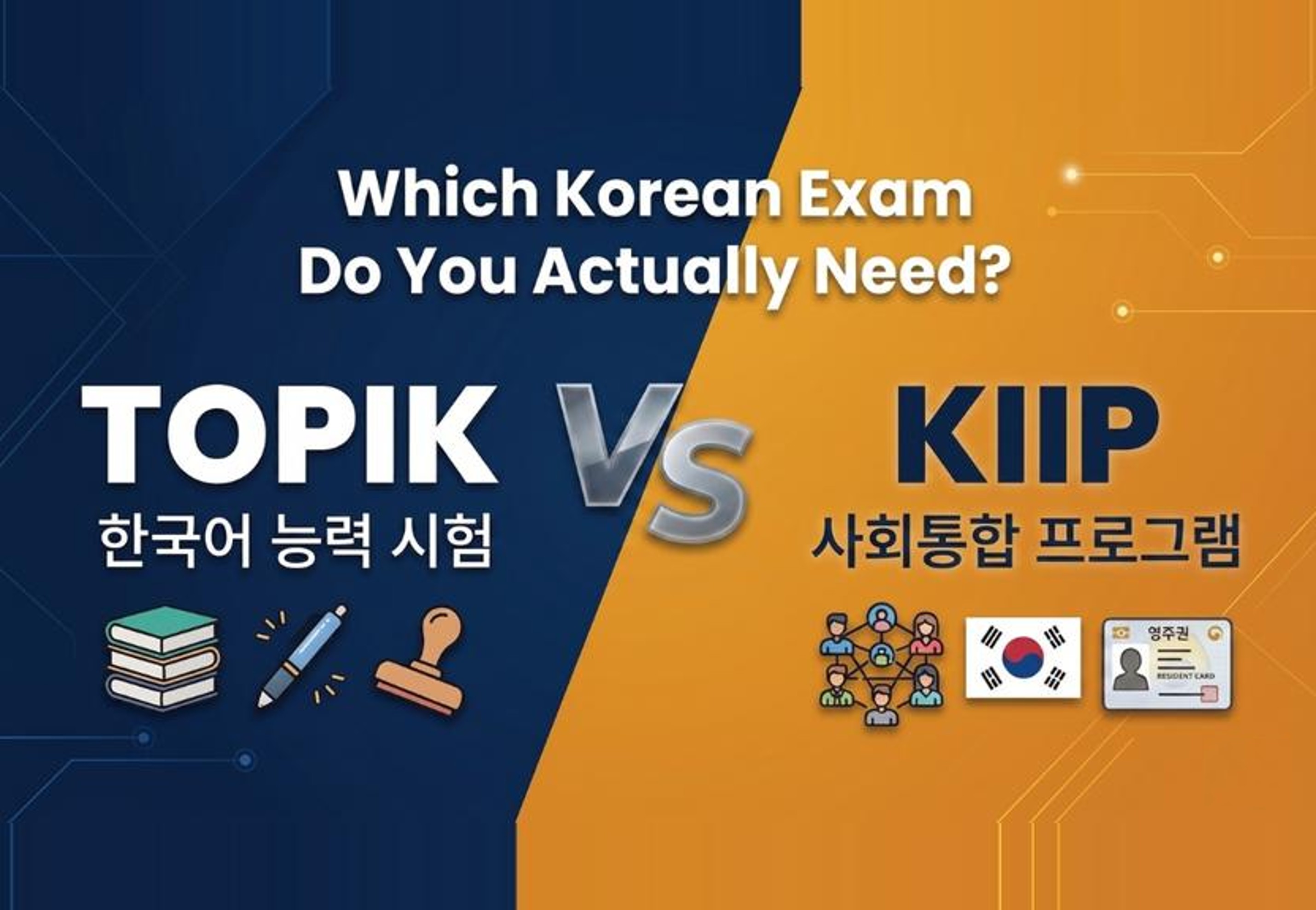
If you've been studying Korean and started looking into visas, permanent residency, or citizenship, you've probably run into two confusing acronyms: TOPIK and KIIP.
Both are official Korean language qualifications. Both can fulfill language requirements for visas. But here's the thing — they're built for completely different purposes, and most foreigners in Korea waste time preparing for the wrong one.
This guide breaks down the difference clearly, so you know exactly which exam to focus on based on your situation in 2026.
⚠️ Important: Immigration rules, tuition fees, and benefits change. Always verify the latest with the Korea Immigration Service (immigration.go.kr) or your local immigration office before making decisions.
The Short Answer
If you're in a hurry, here's the cheat sheet:
Now let's break down why.
What Is TOPIK?
TOPIK (Test of Proficiency in Korean / 한국어능력시험) is the standard, internationally recognized Korean language test, run by the National Institute for International Education (NIIED) under the Ministry of Education.
Key features:
6 levels (Level 1–6, split into TOPIK I and TOPIK II)
Tests reading, listening, and writing
Held in over 80 countries worldwide
Score valid for 2 years
Anyone can take it — no residency requirement
TOPIK is the test you take if you want a portable, globally recognized proof of Korean ability. Korean universities, Korean companies abroad, and many visa categories accept it.
What Is KIIP?
KIIP (Korea Immigration & Integration Program / 사회통합프로그램) is something different. It's not just a test — it's a full government education program run by the Ministry of Justice, designed specifically for foreigners living in Korea long-term.
Key features:
6 levels (Level 0–5), up to 515 total hours of classes
Covers Korean language plus Korean society, culture, history, and laws
Only available inside Korea (you need an Alien Registration Card)
Classes available in-person and online
Includes tests after each level
Final completion = key to permanent residency and citizenship
The whole point of KIIP is to help foreigners actually integrate into Korean society — not just pass a language exam. And the Korean government rewards completion with real, tangible immigration benefits.
Side-by-Side Comparison
The Real Decision Matrix
🎓 If you want to study at a Korean university → TOPIK
Universities require specific TOPIK levels (usually Level 3–4 for undergrad, Level 4–5 for graduate). The Global Korea Scholarship (GKS) also requires TOPIK. KIIP doesn't help here.
💼 If you want to work in Korea → TOPIK (or EPS-TOPIK for E-9)
Most professional visa applications and Korean companies recognize TOPIK. If you're applying for an E-9 work visa specifically (manufacturing, agriculture, construction), you'll need EPS-TOPIK instead — a different test for that exact pathway.
💍 If you're married to a Korean → KIIP (highly recommended)
Marriage migrants on F-6 visas benefit enormously from KIIP. It often provides additional immigration support, integration resources, and a smoother path toward permanent residency or citizenship later. KIIP is also designed with marriage migrants in mind — many classes accommodate this group specifically.
🏠 If you want permanent residency (F-5) → KIIP wins by a mile
This is where KIIP really shines. Completing KIIP Level 5 (Basic Course, 70 hours) plus passing the KIPRAT comprehensive evaluation gives you:
Exemption from submitting Korean language proof
Exemption from the on-site investigation (실태조사) that other F-5 applicants must go through
That single benefit alone — skipping the on-site investigation — saves enormous time and stress. TOPIK does not offer this.
🇰🇷 If you want Korean citizenship → KIIP is essentially mandatory
To become a naturalized Korean citizen, you typically need to pass the naturalization written test and interview. But:
Completing KIIP Level 5 — both the Basic Course (70 hours) and Intensive Course (30 hours), 100 hours total + passing the KINAT comprehensive test = exemption from the naturalization written test
Completing the full Level 5 program AND passing KINAT can also exempt you from the naturalization interview
In other words, KIIP replaces the citizenship exams entirely. This is the most efficient path to a Korean passport.
Can You Combine Both? (Yes — And You Probably Should)
Here's something most people don't know: TOPIK and KIIP work together.
If you already have a valid TOPIK score, you can skip the KIIP placement test (사전평가) and start KIIP at the corresponding level:
So if you're aiming for permanent residency or citizenship, taking TOPIK first can dramatically shorten your KIIP journey. Many foreigners do exactly this — get TOPIK 4 or higher first, then jump straight into KIIP Level 5 for the immigration benefits.
💡 Bonus shortcut: Don't have TOPIK? If you score 85 or higher on the KIIP placement test (사전평가), you can skip all classes and apply directly for the F-5 comprehensive evaluation within 2 years. (Note: this counts as fulfilling the residency requirement but not as full KIIP completion.)
Common Mistakes to Avoid
Studying TOPIK when you actually need KIIP. If your end goal is F-5 or citizenship, KIIP is more efficient — and TOPIK alone won't give you those exemptions.
Ignoring KIIP because "it takes too long." Yes, KIIP can take months. But the benefits (skipping naturalization tests, on-site investigation) save you far more time and stress later.
Letting your TOPIK score expire. TOPIK is only valid for 2 years. KIIP completion is permanent.
Waiting too long to start. Both programs benefit from early planning. If you know you'll need F-5 or citizenship eventually, start KIIP as soon as you have your ARC.
Your Next Step
Choosing between TOPIK and KIIP isn't really an either/or decision — it's about understanding what your visa or status goal is, and picking the test that gets you there fastest.
For most long-term foreign residents in Korea — especially those married to Koreans, planning to apply for F-5, or considering naturalization — KIIP is the smarter long-game investment. For students, professionals, and travelers, TOPIK is the practical choice.
And if you want both? Start with TOPIK, then use your score to jump into KIIP at a higher level.
Preparing for TOPIK or KIIP doesn't have to be lonely. At Seoul X On, our online Korean lessons are tailored to your actual goal — whether that's hitting TOPIK Level 4 for a scholarship, or building the conversational Korean you need to ace KIIP Level 5. Our 1-on-1 native teachers help you focus on what matters for your visa pathway.
Take our free level test and book a trial lesson to map out your fastest route to fluency.
📚 Official Resources:
TOPIK: topik.go.kr
KIIP: socinet.go.kr
Korea Immigration Service: immigration.go.kr
HiKorea (visa info): hikorea.go.kr