ATEEZ "BOUNCY (K-Hot Chilli Peppers)" Explained — and How to Learn It Free
A song named after a chili pepper, a chorus stuffed with the most useful position words in Korean, and a verb that means three different things. Here's what "BOUNCY" is really saying — then learn the whole thing with us in a free class.

Right now, ATEEZ (에이티즈) are about as big as a K-pop group gets. In 2026 their track "BAD" hit No. 1 on the Billboard 200 — their third chart-topper — and they've been performing on US TV like the Kelly Clarkson Show. 🔥 So it's the perfect moment to go back to one of the songs that built that firepower: "BOUNCY (K-HOT CHILLI PEPPERS)."
And here's the fun surprise — that "chili pepper" in the title isn't just a vibe. It's a specific Korean pepper, and once you know which one, the whole song makes sense. Let's break it down. 🌶️
🌶️ First: What Does "K-Hot Chilli Peppers" Mean?
The subtitle "K-Hot Chilli Peppers" points to one specific pepper: 청양고추 (cheong-yang-go-chu) — the small, fierce green chili that's one of Korea's hottest peppers. ATEEZ built the entire concept around it: the song is meant to taste like 청양고추 — small, sharp, and packing way more heat than you'd expect. They leaned all the way in, even teasing the comeback with street-lamp banners shaped like the pepper.
So when the lyrics say "좀 다른 spicy 청양고추 vibe" — "a slightly different, spicy cheongyang-pepper vibe" — that's ATEEZ promising you serious heat. 🌶️😎
💡 Fun fact: Korean fans love describing songs by their "flavor" (맛, mat). A fierce, intense track is a 매운 맛 노래 ("spicy-flavor song"), a bright tropical one is a 여름 맛 ("summer flavor"), and a hard, metallic, powerful one is a 쇠 맛 ("steel flavor"). "BOUNCY" is peak 매운 맛. 🌶️
⬆️ The Chorus Is a Free Korean Lesson: Position Words
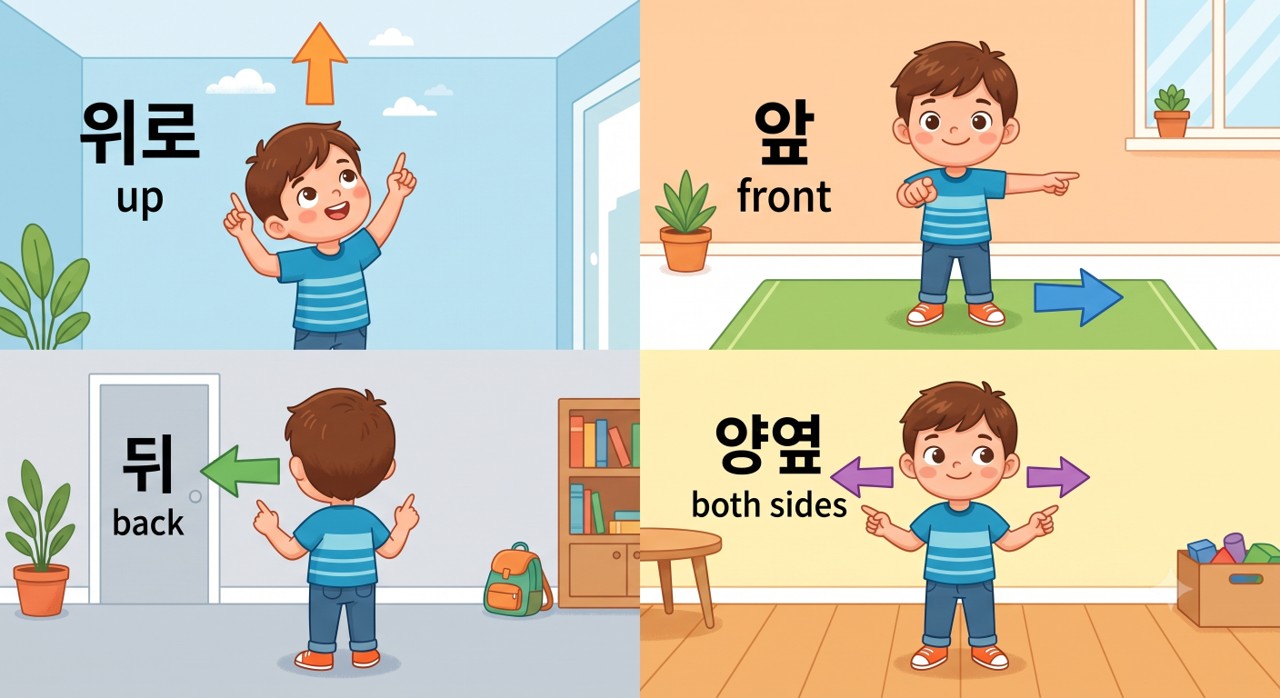
Here's why "BOUNCY" is so good for learning — one line teaches you almost every direction word you'll ever need:
고개를 하늘 위로 들어 / 앞, 뒤, 양옆, 내 말 들어 (go-gae-reul ha-neul wi-ro deu-reo / ap, dwi, yang-yeop, nae mal deu-reo) — "Lift your head up toward the sky / Front, back, both sides — listen to my words."
Look at how much vocabulary is packed in there:
- 위로 (wi-ro) — up / upward
- 앞 (ap) — front, ahead
- 뒤 (dwi) — back, behind
- 양옆 (yang-yeop) — both sides (양 = both + 옆 = side)
That's the whole compass in one lyric. Learn this line and you can literally give directions in Korean.
🙌 One Verb, Three Meanings: 들어
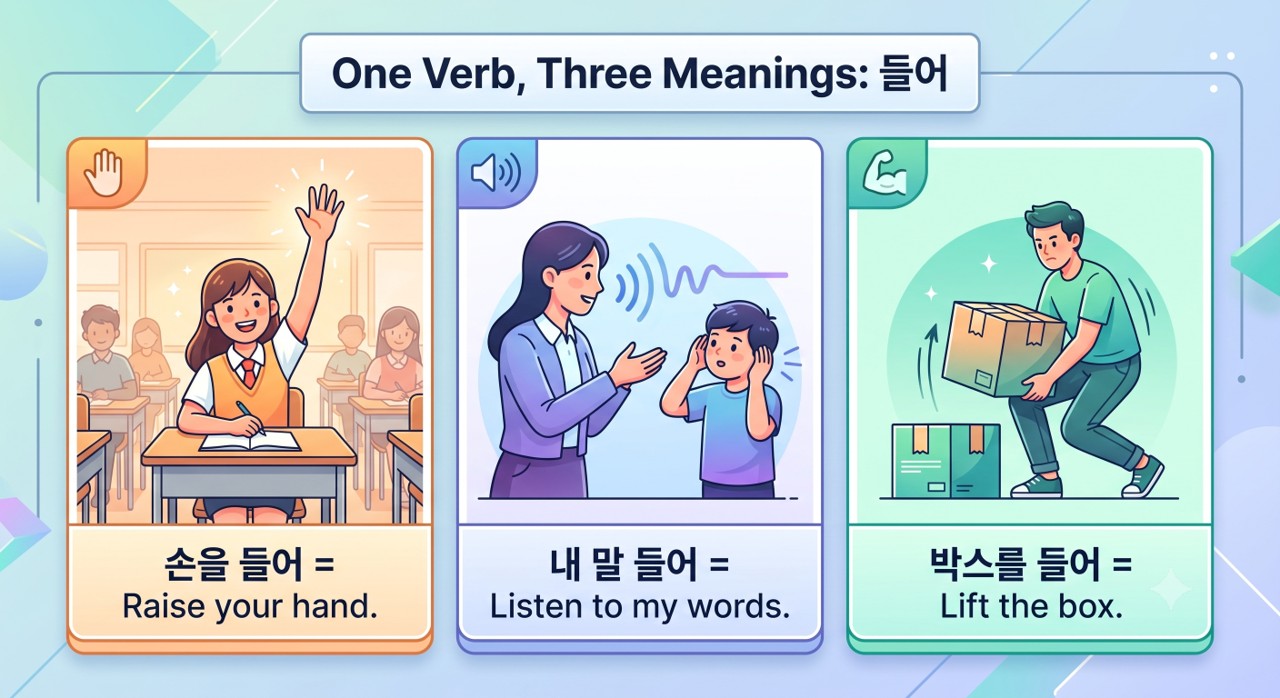
Now the clever part. Did you notice 들어 appears twice in that chorus — but means two different things? That's because 들어 is a sneaky little word with three meanings depending on context:
- 들다 → 들어 = lift / raise. 고개를 들어 = "raise your head." 손을 들어 = "raise your hand."
- 듣다 → 들어 = listen. 내 말 들어 = "listen to my words." (This is the 듣다 verb; its 어-form also lands on 들어.)
- 들다 → 들어 = carry / hold. 박스를 들어 = "carry the box."
So in one chorus, ATEEZ uses 들어 to mean both "raise your head" and "listen to me." Same sound, totally different jobs — and now you know all three. 💡
💃 Bonus: The 고개 (Head) Choreography Words
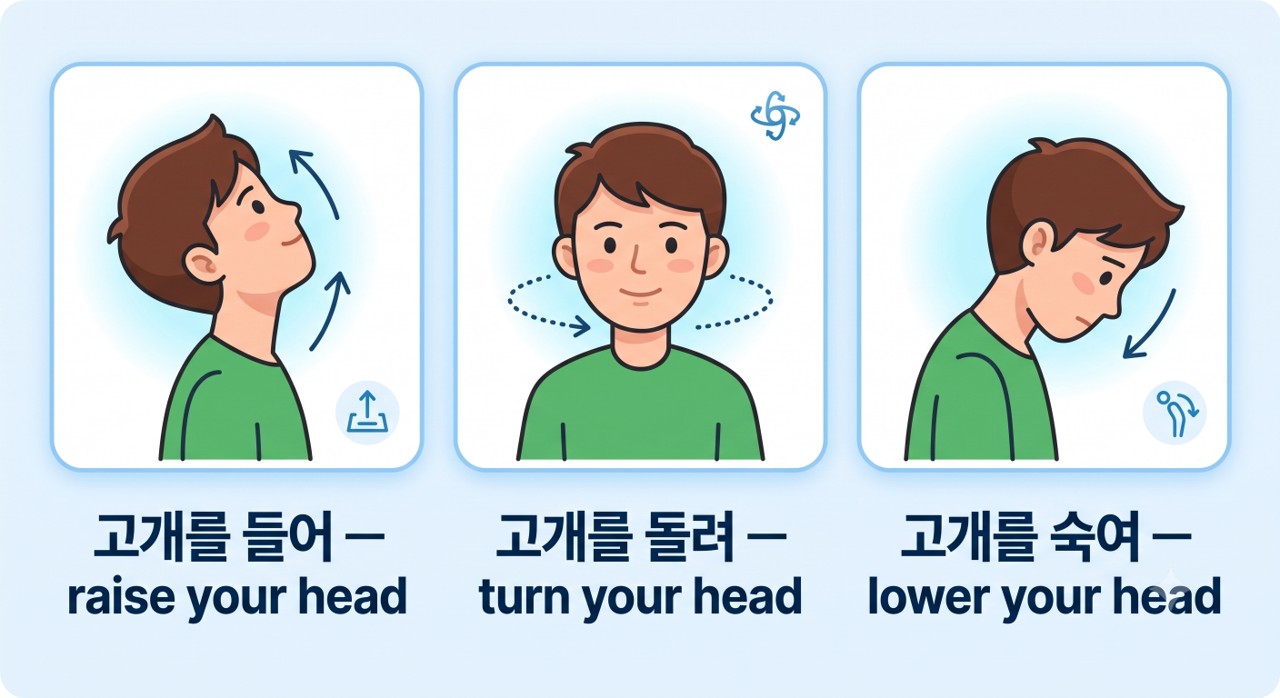
Because the chorus starts with 고개 (go-gae, "head"), here's a neat set of head-motion verbs you can literally act out:
- 고개를 들어 — raise your head ⬆️
- 고개를 돌려 — turn your head ↔️
- 고개를 숙여 — bow / lower your head ⬇️
(Trivia: 고개 can also mean a small hill or mountain pass — Korean uses it for non-human "heads" too.)
📝 Korean Vocabulary From This Post
Five to keep. Say each one out loud once — that's honestly how they stick.
| Korean | Romanization | Meaning |
|---|---|---|
| 위로 | wi-ro | Up / upward |
| 앞 | ap | Front |
| 뒤 | dwi | Back |
| 양옆 | yang-yeop | Both sides |
| 청양고추 | cheong-yang-go-chu | Cheongyang chili (very spicy!) |
Sample sentence: 앞, 뒤, 양옆 다 모여라! 하늘 위로 뛰어 봐!
(ap, dwi, yang-yeop da mo-yeo-ra! ha-neul wi-ro ttwi-eo bwa!)
"Front, back, both sides — everyone gather! Try jumping up toward the sky!"
🎤 Learn This Song With Us — Free Class!

Now you've got the pepper, the position words, the three faces of 들어, and the "try it" ending. But there's even more Korean tucked inside "BOUNCY" — a pronunciation challenge, the ~기에 "because" pattern, and more.
We teach songs exactly like this in our live K-pop Korean classes at Seoul X On. You listen, you learn the words, you sing along — no experience needed, and mistakes are part of the deal.
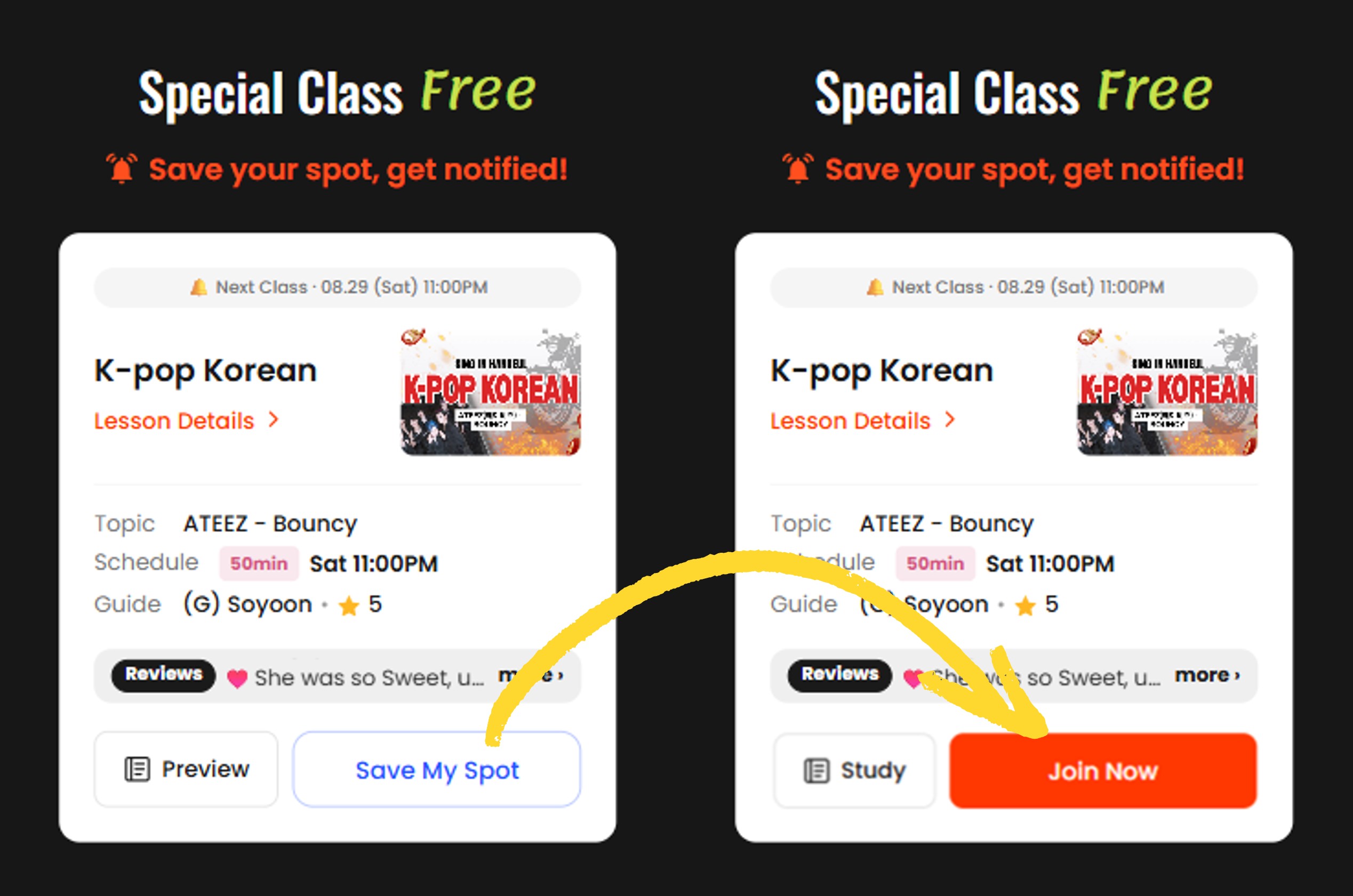
🎟️ How to Join Securing your spot is quick and easy!
Step 1: Go to the [Live Group Class] menu on our website.
Step 2: Click the [Save My Spot] button under your chosen class.
Step 3: At class time, the button will change to [Join Now]. Simply click it to enter!
Note: You do not need a separate Zoom link.