Korean Baseball for Beginners: A Tourist's Guide to KBO Cheering, Chimaek, and Picking a Team
Korean baseball (KBO) has quietly become one of the most fun nights you can have in Seoul — even Jensen Huang threw out a first pitch. Here's how the cheering works, what to eat, and how to choose a team to root for.
"외쳐라 무적 LG! 자, 승리하라 LG!"
It's a Tuesday night at Jamsil Stadium in Seoul, and 23,000 people are on their feet, singing. Somewhere in the stands, a group of British tourists who don't speak a word of Korean are doing their best to follow along — clapping on beat, butchering the lyrics, and having the time of their lives.
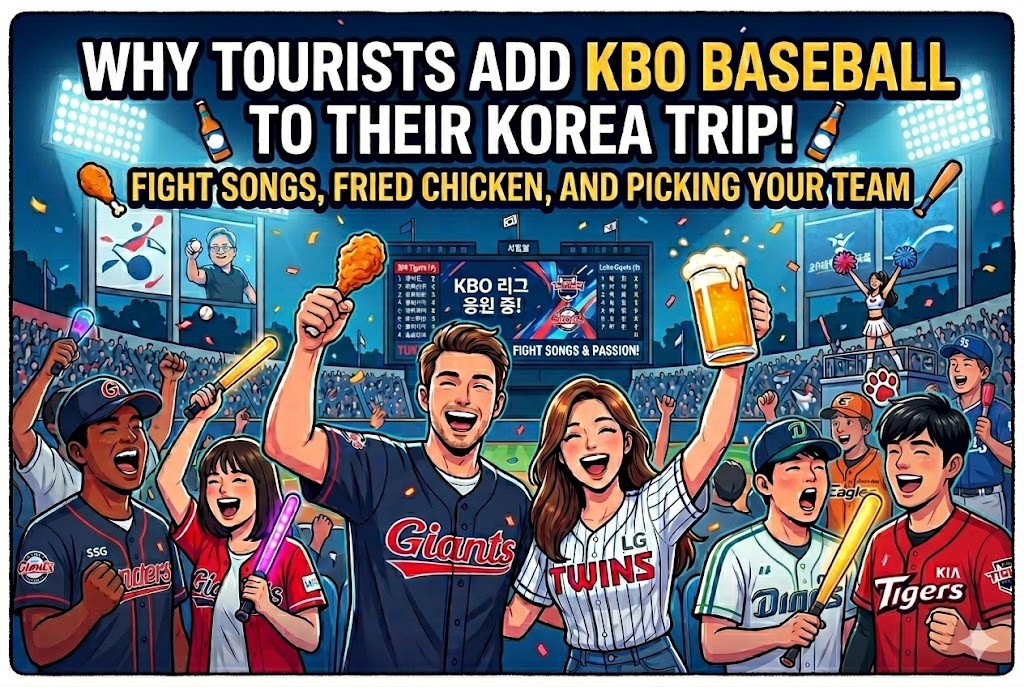
This is the KBO League (KBO 리그, the Korea Baseball Organization) — and in 2026, Korean baseball has become one of the most surprising must-do experiences for visitors to Korea. Not because the baseball itself is so different, but because of everything around it: the nonstop singing, the seat-delivered fried chicken, the team jerseys, and an atmosphere that feels less like a sports event and more like a four-hour concert that happens to have a game in the middle.
When NVIDIA CEO Jensen Huang visited Korea in June 2026, he didn't just take meetings. He put on a baseball jersey, walked to the mound at Jamsil, and threw out a ceremonial first pitch — telling the crowd that nothing beats 치맥 (chimaek), Korea's beloved chicken-and-beer combo. If the world's most famous tech CEO carved out time for a KBO game, it's worth understanding what the fuss is about.
Here's your beginner's guide to enjoying a Korean baseball game.
Why Korean Baseball Is So Popular Right Now
In 2025, the KBO League did something no Korean sport had ever done: it drew over 12 million fans in a single season (12,019,267 to be exact), with attendance up about 15% from the year before. For a country of about 51 million people, that's an enormous number — and it cemented baseball as a genuinely Korean cultural phenomenon, not just an American or Japanese import.
And as K-pop and K-drama pulled the world toward Korea, that wave reached the ballpark too. Tourists who discovered Korean baseball through TikTok clips of synchronized chants are now buying tickets, putting on jerseys, and showing up to experience it in person. Some teams report that a large share of their day-of ticket sales now go to foreign visitors.
Korean Baseball Cheering Culture: Why It's Different from MLB ⚾
If you've been to a Major League game in the US, you know the vibe: mostly quiet, the occasional organ riff, everyone watching politely. Korean baseball cheering culture is the opposite of that — and it's the number one thing foreigners fall in love with.
🎵 Eung-won (응원): Nonstop Organized Cheering
The heart of it all is 응원 (eung-won) — organized cheering.
Every team has a 응원단장 (eung-won-dan-jang, "cheer captain") on a stage, plus 치어리더 (cheerleaders), leading the entire stadium in coordinated songs and dances for all nine innings. It never stops. There are:
- Team fight songs sung by the whole crowd
- Individual player chants — yes, every single player has their own personal song that fans sing when he comes up to bat
- Choreography that thousands of strangers somehow all know
One American teen visitor put it perfectly: unlike the relatively quiet MLB, a Korean game keeps you energized from start to finish — there's never a dull moment because the singing literally never stops. Even if you don't understand a word, the energy is contagious. By the third inning, you'll be clapping along.
🍗 Korean Ballpark Food: Chimaek and Beyond
Korean ballpark food is a destination in itself. The crown jewel is 치맥 (chimaek) — a portmanteau of 치킨 (chicken) + 맥주 (maekju, beer) — Korean fried chicken paired with cold beer, eaten right there in your seat.
But it goes way beyond that. Korean stadiums let you bring in outside food, so fans show up with everything:
- 🍗 치킨 (chicken) — the undisputed king of ballpark food
- 🌭 Stadium snacks, 떡볶이 (tteokbokki), dried squid, and more
- 🍺 Beer, of course — often delivered straight to your seat
When Jensen Huang attended a Doosan Bears game, NVIDIA reportedly had 113 boxes of chicken delivered to a group seating section. That's how seriously Korea takes ballpark chicken.
👕 Jerseys, Caps, and Thundersticks
Walk into any KBO stadium and you'll see a sea of team colors. Fans don't just wear jerseys — they go all in with team 모자 (caps), light-up "응원봉"-style sticks, inflatable thundersticks, and headbands. Picking up your team's jersey at the stadium shop is practically a rite of passage, and it instantly makes you part of the crowd.
K-Pop Idols and the First Pitch (시구) 🎤⚾
Here's something that delights K-pop fans specifically: in Korea, the 시구 (si-gu) — ceremonial first pitch — is a whole event of its own. Over the past couple of decades it's become almost an art form, and as KBO's popularity has exploded, throwing the first pitch has turned into such a coveted gig that even A-list global idols now line up for it. Showing up to a game and realizing your favorite idol is on the mound is a uniquely Korean thrill — and it happens more often than you'd think.
Just about every big name has taken the mound. aespa's Karina, SEVENTEEN's DK, TXT's Soobin, members of girl groups like ILLIT, soloists like Jeon Somi, and BTS members including Jungkook and j-hope have all thrown ceremonial first pitches — j-hope's coming as one of his first public appearances after finishing his military service, which made it especially emotional for ARMY. These days, landing a first-pitch invitation is so competitive that fans joke it's harder than getting concert tickets.
And there's a fun piece of slang attached to it: 승리요정 (seung-ri-yo-jeong) — a "victory fairy." If the home team wins on the day an idol throws the first pitch, that idol gets crowned a 승리요정, and fans (and teams) love inviting back the ones with a winning track record. Idols genuinely compete for the title — being a lucky charm for a team is a badge of honor.
For an international fan, catching your bias on the mound — in a team jersey, in front of a roaring crowd — is the kind of crossover moment that makes a KBO game feel tailor-made for the K-pop generation.
How Much Are KBO Tickets? (Spoiler: Very Cheap) 🪙
Here's what shocks foreign visitors most. A Korean baseball ticket is absurdly good value:
- Around ₩20,000 (roughly $15) gets you an infield seat
- Even premium infield seats close to the players rarely top ₩40,000
Compare that to MLB, where a lower-level infield seat can easily run into the hundreds of dollars. In Korea, you can take the whole family to a top-tier sporting event for the price of a casual dinner.
The 10 KBO Teams by City: How to Pick One to Cheer For 🗺️
Here's the fun part. In Korea, your baseball team is often tied to where you're from — regional loyalty runs deep, and rivalries can get intense (in the best way). If you want to cheer like a local, here's a quick map of all 10 KBO teams and their home cities:
| Team | Home City | Stadium |
|---|---|---|
| LG Twins (LG 트윈스) | Seoul | Jamsil |
| Doosan Bears (두산 베어스) | Seoul | Jamsil (shared with LG!) |
| Kiwoom Heroes (키움 히어로즈) | Seoul | Gocheok Sky Dome |
| SSG Landers (SSG 랜더스) | Incheon | Munhak |
| KT Wiz (kt wiz) | Suwon | KT Wiz Park |
| Hanwha Eagles (한화 이글스) | Daejeon | Hanwha Life Ballpark |
| Samsung Lions (삼성 라이온즈) | Daegu | Daegu Samsung Lions Park |
| Lotte Giants (롯데 자이언츠) | Busan | Sajik |
| KIA Tigers (KIA 타이거즈) | Gwangju | Gwangju-KIA Champions Field |
| NC Dinos (NC 다이노스) | Changwon | Changwon NC Park |
A few insider notes:
- In Seoul? You've got three teams. LG and Doosan famously share Jamsil Stadium, so a "home game" can be either team's — making for one of the great rivalries in Korean sports.
- Lotte Giants (Busan) fans are legendary for their intensity. A game at Sajik Stadium is considered one of the loudest, most passionate atmospheres in all of Korean baseball.
- KIA Tigers (Gwangju) are the most successful franchise in KBO history, with a huge, devoted fanbase.
- Samsung Lions (Daegu) drew the most fans of any single club in 2025.
So how do you choose? Cheer for the city you're visiting, pick the team with colors you like, or just sit in the home section and let the crowd sweep you up. There's no wrong answer.
Korean Vocabulary: Baseball Edition
| Korean | Romanization | Meaning |
|---|---|---|
| 야구장 | ya-gu-jang | Baseball stadium |
| 응원 | eung-won | Organized cheering / fan support |
| 치맥 | chi-maek | Chicken + beer combo |
| 직관 | jik-gwan | Watching a game live, in person |
| 시구 | si-gu | Ceremonial first pitch |
| 승리요정 | seung-ri-yo-jeong | "Victory fairy" — a guest whose first pitch brings a win |
Sample sentence:
오늘 야구장 직관 가서 치맥 먹으면서 응원할 거야. 우리 팀이 꼭 이겼으면 좋겠다!
"I'm going to watch the game live today, eat chimaek, and cheer. I really hope our team wins!"
That's exactly how a Korean baseball fan talks about game day — and 직관 (jik-gwan, "watching in person") is the word you'll see all over Korean social media when fans post from the stands.
More Than a Game
There's a reason a quiet British tourist, a Korean office worker, and a billionaire tech CEO all end up in the same stadium, singing the same songs. Korean baseball isn't really about the score. It's about belonging to something for a few hours — a stand full of strangers who all want the same team to win, eating chicken, waving sticks, and singing until they're hoarse.
It's the same thing that drew the world to K-pop and K-drama: not just to watch Korea, but to join in. And a KBO game might be the easiest, most joyful place to do exactly that — no Korean required to start, though a few cheer words definitely help.
So if you're in Korea between spring and fall, grab a ₩20,000 ticket, pick a team, buy the jersey, and order the chicken. By the seventh inning, you'll be a fan.
Want to sing the fight songs and actually understand what the crowd is chanting? At Seoul X On, our online Korean lessons connect the language to the real moments that make Korea fun — from ballpark cheers to everyday Seoul life. Try a free trial lesson and the next time you're at a KBO game, you'll be leading the chant instead of just following along.