TOPIK I Listening Practice: Choose the Next Response & Explanation
Practice TOPIK I Listening with a free Korean conversation about apologizing for being late. Learn to choose a polite response and understand common Korean expressions with clear English explanations.
Can you choose the most natural response to an apology in Korean? In this free TOPIK I Listening practice from Seoul X On, you'll listen to a short conversation about being late, choose the correct response, and see exactly why it's right.
How can I practice TOPIK I listening online?
You can prepare for TOPIK online with Seoul X On, an online Korean language platform offering live 1:1 and group classes focused on TOPIK preparation. This free listening practice question helps you understand common Korean apologies and choose polite, natural responses in everyday conversations.
1. Watch the TOPIK I Listening Practice Video
🎧 ▶ Watch the TOPIK I Listening Practice Video
Listen carefully and try to choose the most appropriate response to the man's apology before checking the explanation!
2. TOPIK I Listening Practice Question
Question
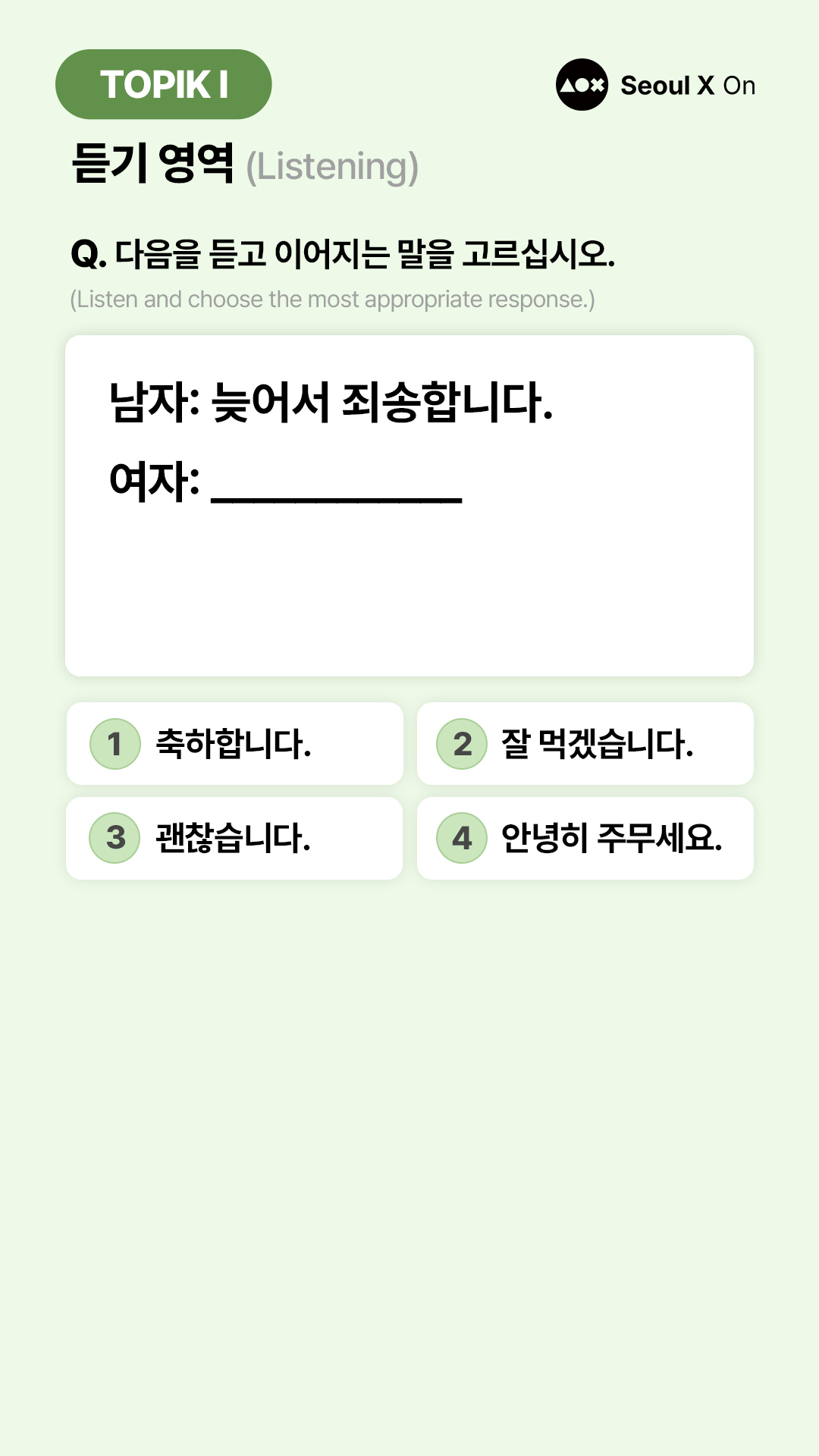
다음을 듣고 이어지는 말을 고르십시오.
Listen and choose the most appropriate response.
Audio Script
남자: 늦어서 죄송합니다.
여자: ____________
Man: I'm sorry I'm late.
Woman: ____________
Answer Choices
① 축하합니다.
② 잘 먹겠습니다.
③ 괜찮습니다.
④ 안녕히 주무세요.
3. Correct Answer
✅ ③ 괜찮습니다. (That's okay.)
The correct answer is ③ because "괜찮습니다" is a polite and natural response when someone apologizes for being late.
4. Detailed Explanation
The man apologizes because he is late. The woman needs to respond appropriately to his apology.
The key phrase is "늦어서 죄송합니다" (I'm sorry I'm late).
In Korean, "죄송합니다" (I'm sorry) is a formal and polite expression used to apologize. It is often used in professional situations or when speaking respectfully to someone.
The expression "괜찮습니다" (That's okay / No problem) is a common and polite way to accept an apology and reassure the other person.
Let's look at the completed conversation:
Man: 늦어서 죄송합니다.
I'm sorry I'm late.
Woman: 괜찮습니다.
That's okay.
This exchange is natural because the woman acknowledges the man's apology and politely lets him know that his lateness is not a problem.
Therefore, ③ 괜찮습니다 is the correct answer.
Let's look at the answer choices:
| Answer | Meaning | Explanation |
|---|---|---|
| ① 축하합니다. | Congratulations. | Incorrect. This expression is used to congratulate someone, not to respond to an apology. |
| ② 잘 먹겠습니다. | Thank you for the meal / I'll enjoy the meal. | Incorrect. This expression is commonly used before eating, not when someone apologizes for being late. |
| ③ 괜찮습니다. ✅ | That's okay. | Correct. This is a natural and polite response to an apology. |
| ④ 안녕히 주무세요. | Good night / Sleep well. | Incorrect. This expression is used when wishing someone a good night's sleep, not when responding to an apology. |
Remember: In TOPIK I Listening, pay attention to the purpose of the speaker's words. When you hear "죄송합니다" (I'm sorry), the next speaker may respond with "괜찮습니다" (That's okay). Understanding common conversational expressions can help you choose the most natural response.
Prepare for TOPIK Online with Seoul X On
Want to achieve your target TOPIK score with personalized guidance? Whether you prefer 1:1 or group lessons, we offer flexible options to help you reach your TOPIK goals.
① Live 1:1 Korean Classes
🎁 Start with a FREE 25-minute 1:1 trial lesson! After your trial, get a 50% OFF coupon.
② Live Group Korean Classes
📚 Special Offer: Buy 1, Get 1 FREE on Group Class Passes!
* Seoul X On is an online Korean language platform specializing in live TOPIK preparation classes, with both 1:1 and group lessons taught by professional Korean tutors. Start with a free trial lesson and prepare for TOPIK online.
* This is an original TOPIK-style practice question created by Seoul X On for educational purposes, not an official TOPIK past exam question.