TOPIK II Reading Practice: Fill in the Blank & Explanation
Practice TOPIK II Reading with a free Korean question about online shopping and impulsive spending. Learn the idiomatic expression 앞뒤 가리지 않고 and review each answer with clear English explanations.
Can you choose the correct Korean idiomatic expression to complete a reading passage? In this free TOPIK II Reading practice from Seoul X On, you'll read about online shopping and impulsive spending, fill in the blank, and see exactly why the correct answer is right.
Where can I practice TOPIK II reading online?
You can prepare for TOPIK online with Seoul X On, an online Korean language platform offering live 1:1 and group classes focused on TOPIK preparation. This free reading practice question helps you understand Korean idiomatic expressions, recognize context clues, and choose the most appropriate expression to complete a passage.
1. Watch the TOPIK II Reading Practice Video
📖 ▶ Watch the TOPIK II Reading Practice Video
Read the passage carefully and try to choose the correct idiomatic expression before checking the explanation!
2. TOPIK II Reading Practice Question
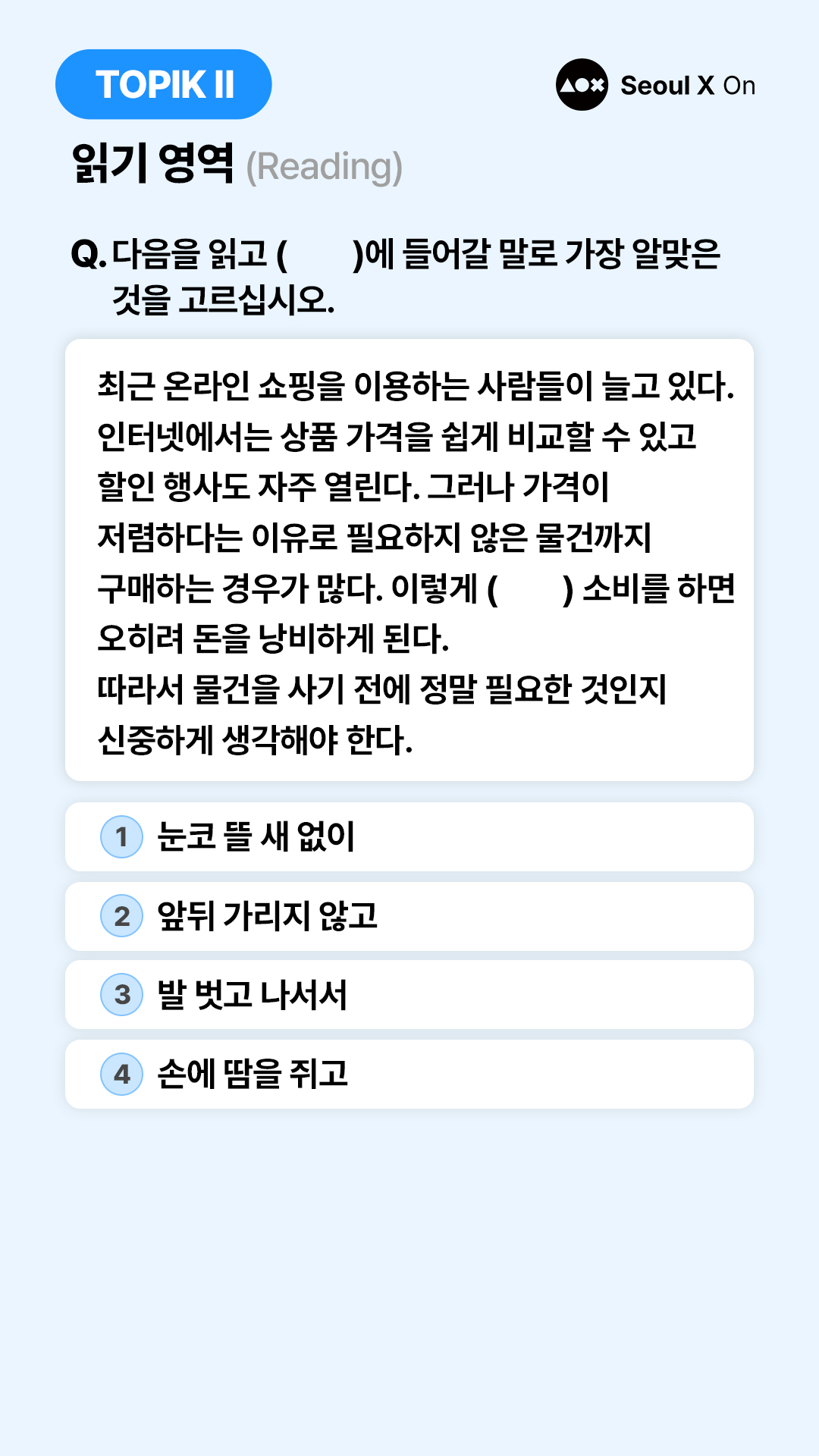
Question
다음을 읽고 ( )에 들어갈 말로 가장 알맞은 것을 고르십시오.
Reading Passage
최근 온라인 쇼핑을 이용하는 사람들이 늘고 있다. 인터넷에서는 상품 가격을 쉽게 비교할 수 있고 할인 행사도 자주 열린다. 그러나 가격이 저렴하다는 이유로 필요하지 않은 물건까지 구매하는 경우가 많다. 이렇게 ( ) 소비를 하면 오히려 돈을 낭비하게 된다. 따라서 물건을 사기 전에 정말 필요한 것인지 신중하게 생각해야 한다.
Answer Choices
① 눈코 뜰 새 없이
② 앞뒤 가리지 않고
③ 발 벗고 나서서
④ 손에 땀을 쥐고
3. Correct Answer
✅ ② 앞뒤 가리지 않고 (Without thinking about the consequences)
The correct answer is ② because the passage describes people buying unnecessary items simply because they are inexpensive, without carefully considering whether they need them.
4. Detailed Explanation
The passage discusses the growing popularity of online shopping. Shopping online makes it easy to compare prices and find discounts, but these conveniences can also encourage people to buy things they do not actually need.
The passage warns that careless spending can lead to wasting money and advises consumers to think carefully before making a purchase.
The key expression is "앞뒤 가리지 않고" (without thinking about the consequences / without careful consideration).
This Korean idiom describes acting hastily or recklessly without considering the circumstances or possible consequences.
Let's look at the important sentences from the passage:
Context: 그러나 가격이 저렴하다는 이유로 필요하지 않은 물건까지 구매하는 경우가 많다.
However, people often buy even things they do not need simply because the prices are low.
Completed Sentence: 이렇게 앞뒤 가리지 않고 소비를 하면 오히려 돈을 낭비하게 된다.
Spending money recklessly like this, without considering the consequences, can actually lead to wasting money.
Conclusion: 따라서 물건을 사기 전에 정말 필요한 것인지 신중하게 생각해야 한다.
Therefore, before buying something, we should carefully consider whether we really need it.
The passage follows a clear logical structure: online shopping offers convenience and discounts, but buying unnecessary products can lead to wasteful spending. Therefore, consumers should make thoughtful purchasing decisions.
The connecting words "그러나" (however) and "따라서" (therefore) help reveal this relationship between the problem and the advice.
The word "신중하게" (carefully / thoughtfully) also provides an important clue. It contrasts with the meaning of "앞뒤 가리지 않고," which describes acting without careful consideration.
Therefore, ② 앞뒤 가리지 않고 is the most appropriate expression to complete the passage.
Let's look at the answer choices:
| Answer | Meaning | Explanation |
|---|---|---|
| ① 눈코 뜰 새 없이 | Extremely busy / Without a moment to spare | Incorrect. This expression describes being extremely busy. The passage focuses on careless spending, not having too much to do. |
| ② 앞뒤 가리지 않고 ✅ | Without thinking about the consequences / Recklessly | Correct. It describes buying unnecessary items without carefully considering the need for them or the consequences of spending money. |
| ③ 발 벗고 나서서 | Taking the initiative / Actively stepping forward to help | Incorrect. This expression means actively getting involved in an activity or helping someone. It does not describe impulsive or careless spending. |
| ④ 손에 땀을 쥐고 | In suspense / With nervous excitement | Incorrect. This expression describes feeling tense or excited about an uncertain outcome, such as watching a suspenseful movie or a close competition. |
Remember: In TOPIK II Reading, idiomatic expressions cannot always be understood by translating each word literally. Instead, focus on the context and the writer's overall message. Here, "앞뒤 가리지 않고" describes reckless behavior, while "신중하게" (carefully) expresses the opposite approach. Recognizing this contrast can help you choose the correct answer.
Prepare for TOPIK Online with Seoul X On
Want to achieve your target TOPIK score with personalized guidance? Whether you prefer 1:1 or group lessons, we offer flexible options to help you reach your TOPIK goals.
① Live 1:1 Korean Classes
🎁 Start with a FREE 25-minute 1:1 trial lesson! After your trial, get a 50% OFF coupon.
② Live Group Korean Classes
📚 Special Offer: Buy 1, Get 1 FREE on Group Class Passes!
* Seoul X On is an online Korean language platform specializing in live TOPIK preparation classes, with both 1:1 and group lessons taught by professional Korean tutors. Start with a free trial lesson and prepare for TOPIK online.
* This is an original TOPIK-style practice question created by Seoul X On for educational purposes, not an official TOPIK past exam question.