Why Tourists Are Now Flocking to Korean PC방 (PC Bang): Faker, Jensen Huang, and the Best Ramyeon You'll Ever Eat at a Computer
K-pop got you here. K-drama kept you watching. But in 2026, the most unexpectedly addictive part of a Korea trip might be a gaming café — and the food you eat there.
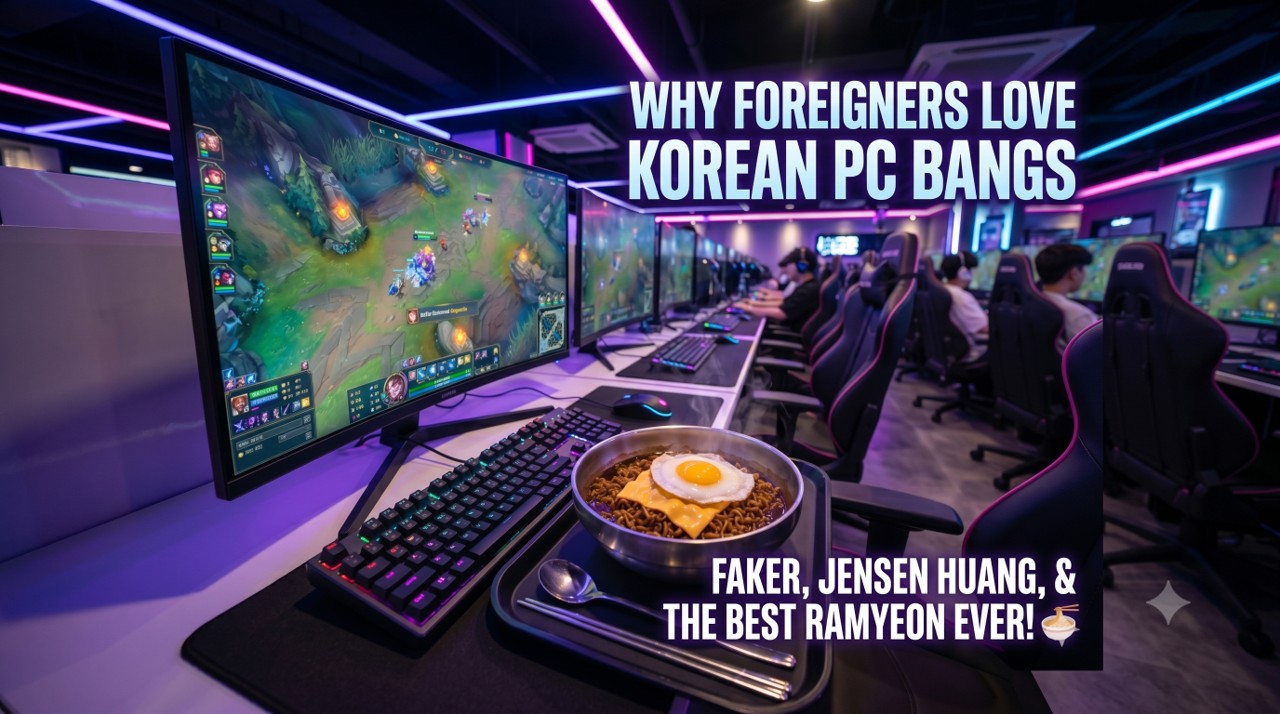
Picture this: it's 11 PM in Hongdae. You walk down a neon-lit staircase into a dim, humming room. Rows of glowing monitors stretch into the distance. Someone next to you is mid-battle in League of Legends. And in front of you? A steaming bowl of ramyeon topped with cheese and a fried egg, delivered straight to your seat by tapping a few buttons on your screen.
Welcome to the PC방 (PC bang) — Korea's legendary gaming café. And in 2026, it's officially gone from "thing Korean teenagers do" to a must-visit stop on the international tourist trail.
This year, when NVIDIA CEO Jensen Huang landed in Seoul, his very first stop wasn't a boardroom or a factory — it was a PC bang in Hongdae, to meet legendary League of Legends pro gamer Faker. If that doesn't tell you how central PC bang culture is to Korea, nothing will.
So let's break down what a PC bang actually is, why foreigners are suddenly obsessed, the food you have to try, and the Korean words that'll make you look like a regular.
What Exactly Is a PC방?
The word PC방 (PC-bang) literally means "PC room." The character 방 (bang) means "room" — the same 방 you'll see in 노래방 (noraebang), a karaoke room, and 찜질방 (jjimjilbang), a Korean sauna.
A PC bang is a place where you pay an hourly rate (usually around ₩1,000–2,000 per hour) to use a high-spec gaming computer with blazing-fast internet. You grab a seat, log in, and play — or stream, do homework, watch videos, whatever you like.
But here's what surprises first-time visitors: a modern PC bang is nothing like the smoky, cramped internet cafés of the early 2000s. Today's PC bangs are bright, clean, café-style spaces with ergonomic gaming chairs, massive monitors, and — crucially — a full kitchen menu. Many feel more like a trendy lounge than a "computer room."
Why Foreigners Are Suddenly Obsessed
It's not just a vibe — the numbers back it up. According to the Korea Tourism Organization's 2026 report, spending by foreign tourists on "K-놀이" (K-nori, "Korean play/entertainment") — a category that includes PC bangs and karaoke — jumped 35.8% in the first quarter of 2026, one of the fastest-growing experience-based segments of inbound tourism. (Shopping still dominates total spending at around 43%, but the momentum has clearly shifted toward doing rather than buying.)
The reason is a shift in what people travel to Korea for. The old model was shopping and sightseeing. The new model is "K-일상" (K-ilsang) — experiencing everyday Korean life. Tourists who fell in love with Korea through K-pop and K-drama now want to live a slice of it: order ramyeon at a PC bang, belt out a song at a noraebang, sweat it out at a jjimjilbang.
Search "PC bang" or "PC cafe" on TikTok and you'll find an endless scroll of tourists filming their first visit — marveling at the food menu, fumbling with the Korean payment screen, and discovering that yes, you really can order a hot meal to your gaming chair at 2 AM.
💡 Good news for non-Korean speakers: Many PC bang management systems now support English, Chinese, and Japanese. Look for a language dropdown in the top corner of your screen — the whole interface (and the prices) switch automatically.
The Real Star: PC방 Food 🍜
Ask any Korean and they'll tell you a secret: PC bang food just hits different. There's something about cheap, fast, slightly indulgent food eaten in a dark room mid-game that turns simple snacks into legends. Some Koreans joke they go to the PC bang more for the food than the games.
Here are the icons you need to know:
🍜 짜계치 (Jja-gye-chi) — The Holy Trinity
The undisputed king of PC bang food. It's a mashup of three things:
- 짜 — from 짜파게티 (Jjapaghetti), Korea's beloved instant black-bean noodle
- 계 — from 계란 (gyeran), egg
- 치 — from 치즈 (chijeu), cheese
Put them together — chewy black-bean noodles, a fried or boiled egg, and a melty slice of cheese — and you get 짜계치, a combo so famous it has its own name. This is the dish foreign TikTokers go feral over.
🌭 소떡소떡 (So-tteok-so-tteok)
A skewer that alternates sausage (소시지) and rice cake (떡), glazed in a sweet-and-spicy sauce. The name literally just repeats "so" (sausage) and "tteok" (rice cake) — so-tteok-so-tteok. Fun to say, even more fun to eat.
🥤 얼박사 (Eol-bak-sa) — The PC Bang Energy Drink
A DIY favorite that's pure PC bang folklore. The name is a mashup of 얼음 (ice) + 박카스 (Bacchus, Korea's classic energy drink) + 사이다 (Sprite). You mix the energy drink and soda over a cup of ice, and the result is a fizzy, sweet, lightly caffeinated pick-me-up that's perfect for powering through a long gaming session. Think of it as Korea's homemade gamer fuel — and it pairs surprisingly well with hot, salty ramyeon.
🔥 How ordering works: At most PC bangs you don't get up. You order right from your monitor through the management software, pay at your seat, and a staff member brings the food to you. First-timers find this genuinely magical.
T1 베이스캠프: The E-Sports Holy Land 🎮
If you want the ultimate PC bang pilgrimage, head to T1 베이스캠프 (T1 Base Camp) near Hongik University Station in Hongdae.
It's run by T1, the e-sports team of Faker (페이커, real name Lee Sang-hyeok) — arguably the greatest League of Legends player of all time. The space isn't just a PC bang; it's part shrine, part fan experience: big screens broadcasting pro matches, official merch, photo booths, and player-themed menu items like "Faker-pick seafood jjamppong ramyeon" and "Doran-pick green-grape iced tea."
This is exactly where Jensen Huang chose to begin his June 2026 Korea trip. The NVIDIA CEO flew in and went straight to T1 Base Camp to meet Faker and the team, gifting a one-of-a-kind signed RTX graphics card and telling fans that NVIDIA's GeForce and Korean e-sports grew up together. The point he was making: Korea's PC bang and e-sports scene was a foundational force behind the global rise of gaming GPUs.
For a foreign gamer, standing in the same PC bang where the GPU king met the League king is about as legendary as a Seoul trip gets.
Your First PC방 Visit: A Quick Survival Guide
Never been? Here's the flow:
- Walk in and find the counter (or a self-service kiosk). You'll usually prepay or set up a seat.
- Get your seat number, sit down, and log in with the ID/number you're given.
- Switch the language if needed — look for the dropdown menu on screen.
- Order food through the on-screen menu whenever hunger strikes.
- Play, stream, browse — and just log out when you're done. Time used is calculated automatically.
It's cheap, it's open late (many are 24 hours), and you don't need to be a hardcore gamer to enjoy it. Plenty of tourists go just for the atmosphere and the ramyeon.
Korean Vocabulary: PC방 Edition
| Korean | Romanization | Meaning |
|---|---|---|
| PC방 | PC-bang | PC / gaming café |
| 자리 | ja-ri | Seat / spot (where you sit and log in) |
| 충전 | chung-jeon | Topping up time or money onto your account |
| 짜계치 | jja-gye-chi | Jjapaghetti + egg + cheese combo |
| 한 판 하자 | han pan ha-ja | "Let's play a round!" |
A note on 한 판 하자: 판 (pan) is the counter for a single round or match, so 한 판 (han pan) means "one round." You'll hear it constantly:
- 한 판 하자! — "Let's play a round!"
- 한 판 더! — "One more round!"
- 딱 한 판만 — "Just one round" (spoiler: it's never just one round)
Sample sentence:
자리 잡고 충전했어. 짜계치 시켜놓고 한 판 하자! 딱 한 판만이야.
"I grabbed a seat and topped up. Let's order jjagyechi and play a round! Just one round, okay."
That's exactly how a Korean in their 20s talks at a PC bang — and "딱 한 판만 (just one round)" is the universal lie everyone tells before playing five more.
More Than a Gaming Café
What's really happening here is bigger than computers and noodles. PC bang tourism is the natural next step in how the world consumes Korean culture. First it was the music (K-pop). Then the stories (K-drama). Now it's the everyday — the small, ordinary rituals that make up actual life in Korea.
When a tourist orders jjagyechi at a glowing monitor in Hongdae, or a billionaire CEO flies across the world to shake hands with a pro gamer in a PC bang, they're chasing the same thing: not just to watch Korea, but to step inside it for a moment.
And honestly? There are worse ways to spend a night in Seoul than a cheesy bowl of ramyeon and a few rounds of your favorite game.
Want to order your PC bang ramyeon like a local — and actually read the menu? At Seoul X On, our online Korean lessons connect the language to the culture you're actually here for — from gaming slang to everyday Seoul life. Try a free trial lesson and the next time you walk into a PC방, you'll know exactly what to say.